


Every Body: The Theme for World Sexual Health Day 2026

Updated: Aug 19
World Sexual Health Day (WSHD) is the annual global initiative of the World Association for Sexual Health (WAS). Each September 4, health professionals, advocates, educators, researchers, and communities around the world come together around a shared theme.
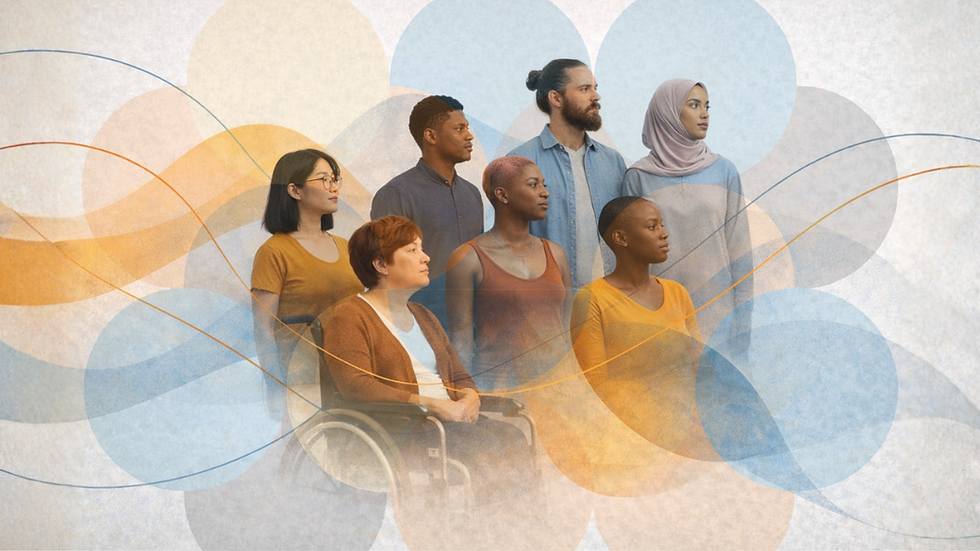
Every Body is the World Sexual Health Day 2026 theme, a declaration that Sexual Health, Rights, Justice and Pleasure belong to every person, in every body, without exception.
Our bodies are ours to know, to explore and to enjoy fully. Sexuality is a central aspect of being human throughout life — in what we think, imagine and desire, in what we believe and value, in pleasure, intimacy and connection, and in every body.
Bodies are personal, relational and political. We live, express and experience through them — asking, choosing, refusing, desiring. That begins with ourselves. It continues in our relationships, in the education and services we can reach, and in the culture, faith, technology and law that decide whose sexuality is protected.

Our Bodies: Where Sexuality, Health, Rights and Justice are lived
Our bodies and ourselves
Ours to know, to explore and to enjoy fully. Pleasure, desire and agency are part of sexual health, at every age and in every body. Let us be at home in them.
Our bodies are a source of pleasure, desire and possibility. Sexuality is a central aspect of being human throughout life — in what we think, imagine and desire, in our fantasies, beliefs and values, in pleasure, intimacy and connection. Sexual health is well-being in relation to all of it, not merely the absence of disease.
Equality, whatever our gender, race, colour, age, socio-economic status, religion, migrant or refugee status or disability, envisages all people being able to equally pursue and experience a satisfying life.
Pleasure, desire, curiosity, affection, touch, intimacy, recognition and belonging are part of sexual health.
With our bodies we feel, desire, respond, change and experience pleasure. Sexual agency includes wanting, initiating, choosing, exploring, changing our minds, and deciding for ourselves what sexuality means.
And bodies are not static: puberty, pregnancy and childbirth, illness, disability, menopause, ageing, medical treatment and gender transition can all change how we live in our bodies and how we experience sexuality. Sexuality can be renegotiated at each of these points, rather than measured against an idealised body or an idealised sexual function.
Our bodies in relation
The people, communities and institutions closest to us — partners, families, faith leaders, schools — can support our sexuality or control it. Respect for bodily integrity, choice and consent is what we uphold for each other, and what each of us can expect in return. Let us be heard.
Relationships come in many forms — romantic, family, friendship, community. Each of them shapes how we live in our bodies, what we feel free to want, and how we understand pleasure. They carry support, companionship and belonging.
Families, communities, faith leaders, teachers and partners shape how we see our bodies and what we come to know about pleasure, about sexual orientation, about gender. They influence whose desire is treated as acceptable and whose is not, and whether we are recognised as having a sexuality at all. Those same relationships can open sexuality up or close it down. They can give the freedom to explore and to want without shame.
That freedom is real when consent and refusal are respected in our own homes and relationships, where most sexual violence happens. When girls' and women's sexuality is not controlled through female genital mutilation and their bodies are not altered. When children are not forced to marry or to give their bodies for sex and reproduction. When sexual orientation, gender identity and expression are not treated as something to be corrected. When intersex children reach adulthood with their bodies intact and the decisions still theirs to make. And when people with disability have their sexuality neither denied nor decided for them.
Sexual health requires a positive and respectful approach to sexuality, to our bodies and to sexual relationships, and the possibility of pleasurable and safe experiences free of coercion, discrimination and violence. What carries this between people is trust, communication and mutual respect. Bodily integrity and consent are what we uphold for each other, and what each of us can expect in return.
Our bodies and the systems around us
Education, information and services are how the right to sexual health reaches people. They work best when they speak about pleasure, support people at every stage of life, and turn no one away. Let these reach every body.
Everyone has the right to the highest attainable standard of health and well-being in relation to sexuality, and to scientifically accurate, understandable information and services on sexuality, sexual health and sexual rights. Schools, clinics and community services are where these rights reach people.
Comprehensive sexuality education is where this begins for most people — in the classroom, in community settings, and increasingly online, and it reaches those who are not in school at all. It builds knowledge step by step, matched to age and to where a person is in their life, covering bodies, relationships, consent, gender and pleasure. Accurate, age-appropriate and free of ideology, it gives people what they need to understand their bodies, their sexuality and their sexual health, and to make their own choices.
Sexuality education and health services work best when they speak about pleasure. HIV and STI prevention that speaks about desire and pleasure achieves more condom use than prevention that speaks only about risk. Services that ask what someone wants from their sexual life, and not only what they should avoid, help people find what actually works for them.
Sexual health needs change across a life, and services should be able to accommodate them. People beginning their sexual lives, at whatever age, may need contraception, condoms and lubricants, testing and treatment for HIV and other sexually transmitted infections, and someone who will talk with them about desire, satisfaction and the difficulties that come up in experiencing their sexuality.
Whether or not to have children is a matter of sexual and reproductive health, autonomy and bodily integrity, and people may need contraception, abortion care or fertility care. Pregnancy and birth, menopause and andropause, illness and its treatment, and later years all reshape a sexual life, and services should support people through those changes.
Sexual health services should be available to everyone on equal terms, whatever a person's age, gender identity, race or sexual orientation, whether or not they sell sex, whether or not they live with a disability, and whether or not they can easily afford care. Adolescents should be able to consult on their own, without a parent's consent, where that serves their interest in a safe and satisfying sexual life.

Our bodies and the politics of sexuality
Culture, faith and technology shape our desires, and law decides whose sexuality is protected and whose is punished. Sexual rights are human rights, and sexual justice is what brings them within reach of everyone. Let us be free and respected.
Media, art, faith, and technology give us language for pleasure, images to recognise ourselves in, and communities to belong to. They also carry shame, and online they spread as much misinformation about sex as information.
Law and policy set the framework within which governments and people act. They determine what is taught in schools, what services are funded, and what may be said in public.
Everyone has the right to think, speak and express themselves freely about sexuality, to organise and take part in public life, and to seek justice and remedy when their rights are violated. Sexual justice addresses the conditions that decide who can exercise those rights and who cannot, and it cannot be achieved apart from gender, racial, economic, health and climate justice.
Laws and policies should be scientifically accurate and should respect sexual rights and sexual justice. Services and comprehensive sexuality education should reach everyone. Misinformation and censorship should be challenged. Funding should be sustained and fairly shared.
How to get involved
World Sexual Health Day is September 4, and the campaign runs all month.
There are many ways to take part. You might hold a conference, run a training session at a clinic, teach a lesson at school, take part in a radio slot, or share a post online. Every one of these counts, and we want to hear about yours.
Tell us what you are doing. It shows the people who fund this work, and the people who make the rules, that it is happening everywhere.
Find the people near you. Someone close by may be doing something similar. Registering will help you find each other.
Make it real. Every Body says that Sexual Health, Rights, Justice and Pleasure belong to everyone. What you do is what turns that into something real.
Visit our resources
A WSHD 2026 themed slide deck, participation guide, social media posts and a film list are available at worldsexualhealthday.org.
REFERENCES
World Association for Sexual Health. (2014). Declaration on sexual rights. https://www.worldsexualhealth.net/was-declaration-on-sexual-rights
World Association for Sexual Health. (2021). Declaration on sexual pleasure. https://www.worldsexualhealth.net/was-declaration-on-sexual-pleasure
World Association for Sexual Health. (2025). Declaration on sexual justice. https://www.worldsexualhealth.net/was-declaration-on-sexual-justice
World Association for Sexual Health. (2025). The Porto Proclamation. https://www.tandfonline.com/doi/full/10.1080/19317611.2025.2597854
World Association for Sexual Health. (2026). World Sexual Health Assembly. https://www.worldsexualhealth.net/post/porto-proclamation-on-sexual-health-rights-and-justice
World Health Organization. (2006). Defining sexual health: Report of a technical consultation on sexual health. https://www.who.int/teams/sexual-and-reproductive-health-and-research/key-areas-of-work/sexual-health/defining-sexual-health


Spider Solitaire 2 Suits is an approachable version of the classic Spider Solitaire card game. By focusing on two suits, it reduces some of the complexity found in more advanced variations while preserving the thoughtful gameplay that makes Spider Solitaire popular.
These kismat heart touch punjabi shayari lines have a thoughtful emotional quality that makes them memorable. The theme of destiny can connect with many personal experiences, especially when relationships and unexpected situations are involved. I liked how these ideas are expressed through simple Punjabi language. Some lines can encourage readers to reflect on their own journey and memories. Overall, this is an interesting collection for people who enjoy emotional Punjabi poetry with deeper life-related meanings.
Mình có lần lướt đọc mấy trao đổi trên mạng شيخ روحاني thì thấy nhắc nên cũng tò mò mở ra xem thử cho biết. Mình không tìm hiểu sâu جلب الحبيب chỉ xem qua trong thời gian ngắn để quan sát bố cục جلب الحبيب cách sắp xếp شيخ روحاني các mục và trình bày nội شيخ روحاني dung tổng thể. Cảm giác là các phần được trình bày khá gọn, các Huren Berlin mục rõ ràng nên đọc lướt cũng không bị rối với mình như Hurentest Berlin vậy là đủ để nắm tin cơ bản rồi. جلب الحبيب
,
,
I admire your ability to convey such detailed information in an accessible way. It took me a little while to read all of the comments, but I found the article to be quite intriguing. the wonderful puppet circus
Snow Rider is a great choice for players who enjoy winter environments, quick arcade challenges, and replayable snowboarding gameplay.