


Every Body: Menopause Is a Sexual Health Issue
- WAS Digital

- 1 hour ago
- 4 min read
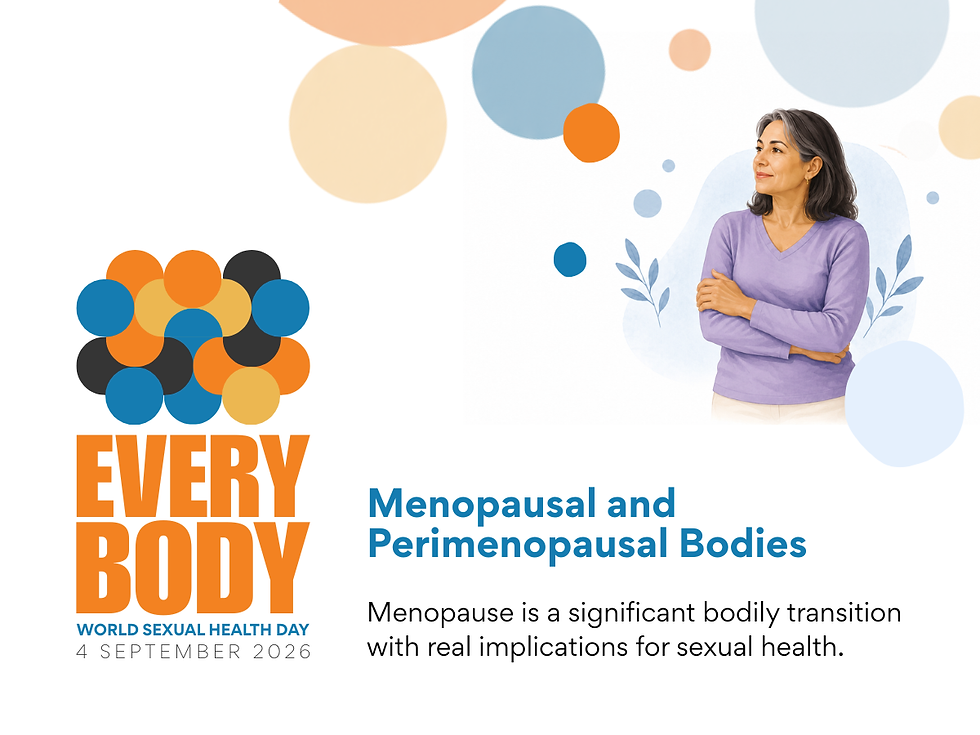
Menopause is one of the most predictable transitions in human life, and one of the least prepared for in clinical practice. A 2024–2025 expert review found persistent, ongoing gaps in menopause care across multiple countries (Di Carlo et al., 2025). For a life stage that touches most people who menstruate, that gap is not incidental.
Grounded in Rights
The WHO/WAS definition of sexual health names access to accurate information and appropriate care as foundational. Sexual health is a state of physical, emotional, mental, and social wellbeing in relation to sexuality, not merely the absence of disease or dysfunction (WHO, 2006). The WAS Declaration on Sexual Rights goes further, affirming the right to the highest attainable standard of sexual health, including access to sexual and reproductive healthcare services (WAS, 2014). Menopausal and perimenopausal sexual health falls squarely within that right. When care systems treat menopause-related sexual concerns as minor, private, or self-resolving, they are failing a rights obligation.
Clinical Minimization of Menopausal Symptoms
The POESIT group's 2025 review of menopause care across Italy, Spain, and Portugal identified a consistent pattern: limited provider knowledge about menopause, combined with inaccurate beliefs about available treatments, functions as a major barrier to people seeking and receiving appropriate care (Di Carlo et al., 2025). This is evidence of a workforce that has not been equipped, through training, guidelines, or institutional priority, to treat menopause as the clinical and sexual health issue it is. Symptoms like vasomotor changes, genitourinary syndrome of menopause, and shifts in desire or comfort during sex are frequently minimized as an unavoidable feature of aging, rather than addressed as treatable conditions with a body of evidence behind them.
The Barrier Is Institutional, Not Personal
It's tempting to assume people simply don't want to discuss menopausal sexual health with a provider. The evidence says otherwise. A 2025 systematic review and meta-synthesis of 21 qualitative studies spanning 610 participants across 13 countries found that healthcare-practitioner knowledge gaps, not patient unwillingness, were the primary barrier to adequate sexual health support during the menopausal transition (Calvin et al., 2025). Across widely different health systems and cultural contexts, the pattern held.
Why Menopause Stays Understudied
The same review frames this knowledge gap explicitly as a funding and prioritization issue: research into women's health concerns, including menopausal sexuality, has historically received less institutional priority and fewer research dollars than comparable areas of medicine (Calvin et al., 2025). Menopause is not scientifically obscure, the biology is well characterized. What's missing is sustained investment in translating that biology into clinical training, guideline development, and public health messaging.
A Measurable Treatment Gap
Female sexual dysfunction affects an estimated 12% of women in the United States, yet primary care physicians report feeling underprepared to manage it (Stanley et al., 2024). Contrast that with erectile dysfunction, which is routinely screened for, discussed, and treated within primary care as a matter of course. Two comparably prevalent conditions. One is normalized clinical territory. The other is frequently left unaddressed. That asymmetry doesn't reflect the relative seriousness of the two conditions; it reflects which one has historically been treated as a priority worth training for.
Why This Matters
None of this is about individual clinicians failing their patients, and it isn't about people needing to be more comfortable discussing their bodies. It's about where research funding has gone, what medical curricula have prioritized, and which forms of sexual health are considered routine versus optional. The WAS Declaration on Sexual Justice, proclaimed on June 18, 2025, names exactly this: the social determinants and structural conditions that produce inequality in relation to sexual health and rights (WAS, 2025).
Every Body, Including People Who Live in Bodies Experiencing Menopause and Perimenopause
"Every Body," the World Sexual Health Day 2026 campaign, explores ten structural themes across the year. This is one of them: people who live in bodies experiencing menopause and perimenopause.
The campaign's four commitments, Sexual Health, Rights, Justice and Pleasure, apply as directly to a person navigating vasomotor symptoms and changes in sexual function at 50 as they do to any other stage of life.
A structural-justice framing asks what system produced this care gap. Every Body includes people whose bodies are in transition.
What Professionals and Institutions Can Do
Build menopause-specific sexual health training into continuing medical education
Audit clinical guidelines and intake protocols for whether menopausal sexual health is asked about proactively
Advocate within institutions for research funding parity between menopause-related sexual health and comparably prevalent conditions like erectile dysfunction
Include transgender men and non-binary people who experience menopause in clinical materials and outreach
Join the Conversation
WAS, WHO, FIGO, and the American University of Beirut continued this conversation in "Menopause on the Brain: Your Questions About Mental Health and Cognition Answered," the second installment in the WHO–WAS–FIGO–AUB Midlife Health, Lifelong Impact series. Watch the replay.
If you work in sexual health, consider joining the global WAS community as an individual or organizational member, and explore the World Sexual Health Day 2026 toolkit at worldsexualhealthday.org.
References
Calvin, A., Cina, S., Byrskog, U., Erlandsson, K., & Borneskog, C. (2025). Women's experiences of their sexuality during their menopausal transition and the support offered to them by healthcare providers: A systematic review and meta-synthesis. European Journal of Midwifery, 9. https://doi.org/10.18332/ejm/209571
Di Carlo, C., Cagnacci, A., Gambacciani, M., Palacios, S., Rebelo, C., Coronado, P., Presa, J., Sánchez, S., Fatela, A., Gomes Ferreira, M., & Nappi, R. E. (2025). Persistent gaps in menopause care: Current recommendations of the POESIT group. Maturitas, 199, 108607. https://doi.org/10.1016/j.maturitas.2025.108607
Stanley, E. E., Pfoh, E., Lipold, L., & Martinez, K. (2024). Gap in sexual dysfunction management between male and female patients seen in primary care: An observational study. Journal of General Internal Medicine. https://doi.org/10.1007/s11606-024-09004-1
World Association for Sexual Health. (2014). Declaration on Sexual Rights. https://www.worldsexualhealth.net/was-declaration-on-sexual-rights
World Health Organization. (2006). Defining sexual health: Report of a technical consultation on sexual health. https://www.who.int/teams/sexual-and-reproductive-health-and-research/key-areas-of-work/sexual-health/defining-sexual-health


Comments